Geoff Colvin, senior editor at large for Fortune, wrote a thought provoking piece entitled, The real outrage is how CEOs are paid, not how much. Colvin looked at CEO compensation from a different angle than is typically viewed with regard to today’s stratospheric CEO salaries. He was not very concerned about the high salaries but rather in the often wrong- headed approach to executive salaries particularly when it came to CEOs. If you are interested in executive compensation and its impact on stock and corporate performance Colvin’s piece is a must read.
NEW YORK, April 19/The Wall Street Transcript/ — In exclusive Q&A interviews with The Wall Street Transcript, Robert Caller, CFO, executive vice president and corporate treasurer of Bally Technologies, and William E. Mudd, CFO and executive vice president of Churchill Downs, weigh the future of the gaming industry and upcoming growth opportunities in this environment of economic recovery.
Mr. Caller outlines Bally’s corporate strategy of focusing on the manufacture and sale of gaming devices, and on the operation of the company’s own gaming device assets, explaining the motives behind Bally’s recent sale of the Rainbow Casino to Isle of Capri. The CFO also discusses Bally’s April 5 announcement to lower its guidance for fiscal year 2011, highlighting the reasons for that decision.
In his exclusive interview with TWST, Mr. Mudd offers in-depth details on Churchill Downs’ acquisition of Youbet.com and explains how this transaction fits into the company’s corporate strategy of diversification away from solely pari-mutuel wagering on horse racing. He also offers a summary of the company’s financials and corporate goals for 2011.
Highlights of both interviews include:
Some key quotes are:
Bally Technologies, Inc., is an international gaming company that designs, manufactures, distributes and operates gaming devices and computerized monitoring, accounting and player-tracking systems for those devices. Bally’s slot data system (SDS) products are used in more than two-thirds of the world’s casinos, in over 3,000 slots.
Churchill Downs, Inc., is a multi-jurisdictional owner and operator of pari-mutuel wagering properties and businesses; it also offers gaming products through its slot and video poker operations in Louisiana and Florida. Aside from the company’s racing operations, which include the Churchill Downs Racetrack, where the Kentucky Derby is hosted annually, Churchill Downs also has an online business, advance-deposit wagering business and gaming business, among other holdings.
The Wall Street Transcript features in-depth Q&A interviews with equity analysts, money managers and public company CEOs. For more than 40 years, TWST has provided primary-source information on public companies to financial professionals, management consultants and senior corporate executives.
The passing of health care reform helped clear the air in the biotech space, creating a rally of M&A activity of small- to mid-cap companies, according to Dr. Jason Kantor, Ph.D., of RBC Capital Markets.
“[W]e’ve seen a number of companies taken out our proposed mergers, which have essentially caused people to look around and see who might be next,” he said. “We are seeing valuations for the small- to mid-cap stocks, which had been particularly punished, now coming back very strongly in 2010.”
And the strength of these stocks rides heavily on the potential effect future mergers could have on valuations. In the past few months, a number of companies have competed for these deals.
“[We] saw Medarex and Genentech (DNA) taken out; we’ve already seen OSI Pharmaceuticals (OSIP) in play in the past weeks, and we’ve seen Facet (FACT), which was originally a target for Biogen (BIIB), ultimately getting taken out by Abbott (ABT) at a significant premium to where the Biogen deal was proposed,” Kantor said.
Although the analyst was underweight the health care sector at the end of 2009, he expects to see a return of funds into both health care and biotech names, bringing both spaces back to at least equal weight. Kantor advises investors to take a basket approach to the biotech sector and keep their eyes on soon-to-come M&A activity.
Earlier today Bank of America BAC (NYSE) under the new leadership of Brian Moynihan made a smart move. The bank appointed Charles Noski as the new CFO. His appointment will fill the vacancy that has been open for a significant amount of time. Noski, an outsider to the bank, is highly qualified. According to Bank of America’s press release.
Noski had been the CFO of defense contractor Northrop Grumman, AT&T, Hughes Electronics and United Technologies. He has also served as a board member for a number of Fortune 500 firms including Morgan Stanley, Microsoft, ADP and others.
The bank continues to make significant management change related steps to right the ship and start moving ahead. This latest major appointment comes on the heels of a number of management related changes Moynihan has already taken in his short tenure as BofA’s new CEO.
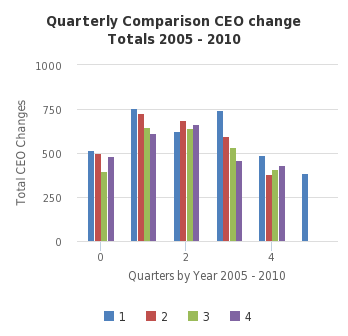
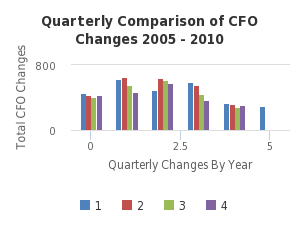
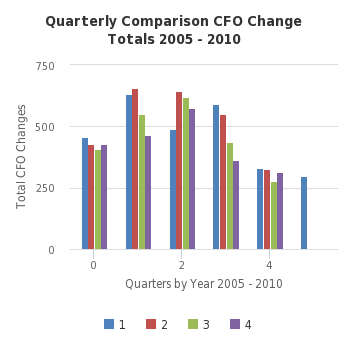
Executive turnover has continued to decline throughout the great economic recession. Liberum’s latest quarterly turnover numbers for CEOs, CFOs, Board of Directors and C-level executives (defined to include CEOs, board of directors, CFOs, COOs, down to VP level) continued to show a drop in turnover for all key categories for the first quarter of 2010. This declining trend in executive turnover has continued since the first quarter of 2008 for all key executive turnover categories (see the CEO, CFO and C-level graphs below for quarterly turnover comparisons). For the first time since early 2008, Liberum expects the declining trend in executive turnover to have bottomed. We expect to see turnover numbers to begin to increase as we move into the second quarter of 2010.
While the first quarter of 2010 continued to show significant declines in executive turnover when compared with the first quarter of 2009, we have finally seen the overall executive turnover declines slowing when the figures are compared with the last quarter of 2009. If this trend continues, increased executive change at the top of companies may actually mean the economy is in for real expansion and growth.
GRAPHICAL REPRESENTATION OF QUARTERLY EXECUTIVE TURNOVER 2005 – 2010
While more and more banks are able to stick their foot in the door and raise capital post recession, increased regulatory pressures have forced them to ratchet up capital requirements, posing a return-on-equity challenge to the industry.
“I think as we lower leverage in the industry, I think that we are going to see lower returns because of that lower leverage,” said Christopher Marinac of FIG Partners LLC. “And of course, it is going to be up to the banks to try and figure out a way to move the needle else wise.”
These capital needs are holding ROE at historic lows, which, according to Marinac, may be here to stay unless banks get creative and start changing how they bring in earnings. He provides several solutions, one being improved margins.
“I’m very optimistic that margin can get better, but I’m cautious because we have a very competitive industry,” he said. “We have very smart customers, both business and consumers, as much as I think credit risk spread should widen. We as an industry should be charging more for it, and we should be paying more for it as consumers and customers.
A company that has been able to make money and grow book value is Hancock Holding (HBHC), says Marinac. Turning to bigger banks as leaders in efficiency, he cites expense cutting as another way to increase profitability.
“You know, we as an industry, particularly as you look at the mid-cap and small-cap banks, are not very efficient. We need to be more like U.S. Bank (USB) or BB&T (BBT), and there are a whole host of others who are efficient,” he said. “I think the more banks either get together and get serious about them doing expense cuts, I think that’s going to make a big difference for this industry. So I do think that as much as I’m probably cautious on ROE, I do think there are ways to get better at it.”
Despite inherent volatility in the biotech industry, analysts are observing an end to the exaggerated instability that characterized the sector for the past two years. As economic recovery takes hold in the U.S., capital markets are becoming more open to cash-intensive drug development companies, easing their access to capital.
“I think one of the reasons we are seeing some of the volatility end is the financing risk had gone up significantly, as you can imagine, during 2008 and 2009, based on the economic crisis that was going on globally,” said Matthew L. Kaplan, managing director of the equity research health care group at Ladenburg Thalmann. “We’ve seen the restrictive capital markets ease as these companies have been able to access capital, really starting since the second half of last year, when it started to become a little bit easier to access capital. In the last nine months or so, capital has become more available.”
Kaplan’s favorite names in the biotech space fall within the therapeutic category, specifically Antares Pharmaceuticals (AIS) and Keryx Biopharmaceuticals (KERX), along with United Therapeutics (UTHR), which is in the cardiovascular space.
“Building a portfolio is one way to invest within the space, which we would advocate,” Kaplan advises, emphasizing the importance of investing in a handful of stocks that collectively produce an attractive risk-return ratio. “For example, if a company doesn’t have a diversified pipeline, you have to build a diversified pipeline on your own as an investor by investing in a variety of companies and building a portfolio, and that’s one way you can mitigate your risk.”
With commercial real estate showing better-than-expected numbers — although still citing major losses — analyst are asking themselves whether the second shoe left to drop in the financial crisis will be more of a ballerina slipper or a workboot?
“Even though commercial real estate is very bad in this cycle versus prior cycles, it’s tracking much better than most of us thought in terms of loan losses. And one reason is restructuring those loans has helped to avoid some of the loss, and it’s postponed,” said Craig Siegenthaler, a senior equity research analyst who covers the financial sector at Credit Suisse. “So CRE, in our view, the hump in terms of the peak is much lower than we thought it was going to be. But it’s still likely going to have a high stream of losses that travel out into 2011 and 2012.”
Although commercial real estate losses are inevitable, Siegenthaler emphasizes that the inevitable might not be as bad as analysts originally predicted, leading to above-average quantity of losses.
“In our view, the inevitable keeps getting better,” said the analyst, pointing out that today’s financial issues have shifted from credit quality to earnings quality.
“All the big issues on credit have now turned into kind of earnings growth. So which loan portfolio is going to do best? What’s going to happen with deposits when the Fed rate is raised?” he said. “It’s clearly kind of an earnings story debate now that shifted from more of a credit quality debate in the last part of last year.”
Siegenthaler’s favorite Midwestern regional bank is Fifth Third Bancorp (FITB), which is currently trading at six times its normalized earnings estimate and has the potential to double that in two years.
Carl Pelzel, President and Chief Executive Officer of Depomed, Inc. (DEPO), talked to the Wall Street Transcript about his company Depomed, Inc. Click here to read the complete interview.
TWST: Depomed is a specialty pharma company that focuses on enhancing pharmaceutical products. But what exactly does that mean?
Mr. Pelzel: What it means is that we are a pharmaceutical company that has a drug delivery technology that’s unique to us, that can be used to develop unique products that have advantages for patients. Now, why is that relevant? Well, there are many pharmaceutical companies that develop brand-new products. For example, they will come out with a new chemical entity and a product that has to go through a lot of toxicology work from the FDA, and they develop the product from the very beginning. And that is very expensive, requires a huge infrastructure and is very risky because you don’t know when you develop such a product what the benefits are going to be. We’re different in that we have a drug delivery technology that takes the existing compounds and makes them better. We feel that model is better for us because we don’t need the huge infrastructure necessary to find new compounds. We don’t take on as much risk associated with the development of our compounds because we’re starting with a known chemical that has been used in humans for many, many years. That means we don’t have as many surprises. The other advantage is that we complete our development programs much faster. So we use this drug delivery platform to make products better, to get them through the FDA and to the market. The advantage is lower cost, lower risk, faster time-to-market and less uncertainty because we’re using compounds that have already been used in man. The downside is that we don’t have as much patent protection as you might with a new chemical entity.
Academics, investors, human resources, board members, corporate executives all have their own opinion on whethdr it is best to outside for a new CEO or hire from within. Liberum continually covers research that points to different conclusions on this question. A new report has come out that claims outside CEO hires tend to increase corporations’ market value. According top a story in Canada’s Globe and Mail, Spencer Stuart, the executive search firm, examined
… the track records of 210 new CEOs of large Canadian companies hired between 1995 and 2006, and measured how much the companies gained in share price during the CEOs’ first three years at the helm.
The results show better performance for CEOs hired from outside in all scenarios, but most especially when the firms are struggling and have forced out their existing CEOs.
The report challenges a view in corporate governance circles that CEOsuccessions work best when internal candidates are selected because they already know the company and need less transition time.
Anyone interested in this issue should contact Spencer Stuart to find out more about the study.