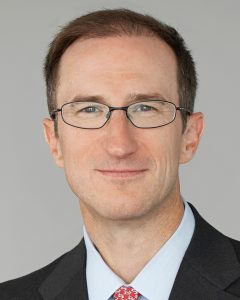
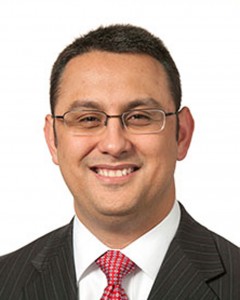
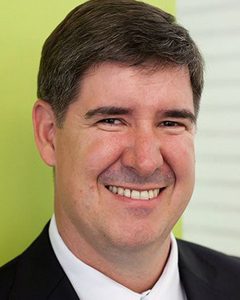
Mark Roberts talks about his bottom-up money management firm. Mr. Roberts primarily uses value stocks, but also invests in growth at a reasonable price. His philosophy is centered around treating each client as an individual. At the present time, Mr. Roberts is recommending that investors keep things short term in the bond market. He also says that dividend-paying stocks make sense for a retiree. He talks about specific stocks and the positive characteristics behind them.
Full interview available here.
Managing Director Sam Peters of ClearBridge Investments says that while MetLife Inc (NYSE:MET) may not look investable to some right now, the company has strong fundamentals, and management is taking steps to lessen interest rate risk.
Most people tell me life insurers are not investable right now with where interest rates are, and I would tell you, if interest rates go higher for whatever reason, there are going to be a lot of things that are not investable, but the life insurance companies will actually become investable, so it’s a little bit of an inversion.
But the key with MetLife is that the management team is acting. They don’t have blinders on, they’re not waiting to get bailed out by interest rates, and they are spinning out their legacy life business later this year and early next year. That will get rid of the big interest rate tail risk, which is the main reason that people consider this not an investable company.
But MetLife still has some excess capital. They’ve got a very good balance sheet, they’ve taken out quite a lot of expenses, and they continue to do that. They’ve been generating good free cash flow, and despite the very, very low interest rates, they are still earning a return on equity of around 10% with very depressed earnings and very depressed fundamentals. Again, interest rates are not flattering them right now, and the company is trading at about one time tangible book value and about 60% of GAAP book, so historically, very cheap.
Christopher Montoya discusses managing his firm’s equity income portfolio, which is an income-based portfolio that has features for price appreciation. Mr. Montoya looks for companies that are attractively valued, ones that are able to pay a growing dividend stream but also have catalysts for price appreciation as well. He talks about the companies he is buying at the current time.
Full interview available here.
James Morton’s equity firm is focused on value and investing in value stocks in Asian markets. As a value investor, Mr. Morton says Asia is right part of the world to be in because it has largely underperformed developed markets in particular. He says there are plenty of value opportunities to uncover and goes in-depth on stocks he finds interesting.
Full interview available here.
Jerry P. Getsos discusses Klingenstein Fields Wealth Advisors. The firm uses bottom-up fundamentals to execute wealth planning and investment management. According to Mr. Getsos, the firm manages for the long term, investing about 70% in equities and 30% in fixed income. Overweighting equities is due to the firm’s belief that interest rates will remain lower for longer, which is positive for equity valuations and the overall economy. In general, Mr. Getsos looks for investments that have clean balance sheets and that are generating free cash.
Full interview available here.
William H. Mann III discusses Motley Fool Asset Management, LLC as well as the Independence Fund and the Great America Fund. The Independence Fund is a go-anywhere fund, which means it can invest globally and across market caps. The Great America Fund invests in domestic small caps and midcaps. According to Mr. Mann, he is a business-centric investor, meaning he focuses on things he can control, such as the quality of a business and the price he is paying for it. He defines quality as companies that can beat their cost of capital over a 10-year period. Mr. Mann does not worry about a fund’s short-term performance or how it compares to a benchmark. In general, the funds are concentrated with 50 to 70 companies, which allows the portfolio managers to know the companies very well and maintain a low turnover.
Full interview available here.
Daniel Kurnos covers e-commerce and internet advertising. He says that for e-commerce the trends are favorable. He says on the other hand that the internet advertising space is tricky with a lot of pluses and minuses. When lumping mobile into that area, he says it is clearly a growth category, but that tailwinds are still being figured out.
Full interview available here.
Senior Vice President Christopher Montoya of First Financial Trust says Apple Inc. (NASDAQ:AAPL) is inside of a long-term growth phase and should appeal to investors who are looking for income.
[Apple] currently trades at 13 times 2016 earnings estimates. And if you go one more year out to 2017, the stock is actually trading for 12 times earnings. And both of these numbers are below the company’s five-year p/e average, and it’s also a huge discount to the overall market. In my opinion, this is too low, especially given the company’s strong operating margins of 30% and net profit margins of 23%.
Apple is, in my opinion, a cash-generating machine. They have over $231 billion of cash on the balance sheet, which enables them to reward shareholders through capital distributions. The dividend yield currently is 2.12%, but the payout ratio is only 21%. This means that the company can grow the dividend tremendously from here.
Apple has been a large purchaser of its stock. Given the hefty cash balances, I think that continues. The stock buyback program serves as a safety net for the stock in case there is any type of pullback in the overall market.
Frederick Moran covers internet and communications-related stocks, specifically data center REITs. Mr. Moran says data center REITs have performed very well over the last two years. He is especially bullish on the data center REITs because of the accelerated demand cycle and increased M&A activity that the sector is seeing. He says investors should buy a basket of data center REIT stocks and enjoy the yields.
Full interview available here.
Chief Investment Officer William Mann III of Motley Fool Asset Management says HDFC Bank Limited (ADR) (NYSE:HDB) is one of his firm’s largest holdings that has appreciated significantly, and it continues to be a company with significant competitive advantage.
HDFC Bank is an Indian bank in a market in which I would describe most of the Indian banking industry as being completely incompetent. They are state-run and very sclerotic.
HDFC Bank is extremely entrepreneurial, and you can tell the superior nature of the bank because they are able to get deposits from people who want to put their money in the bank and offer interest rates that are up to 200 basis points lower than any of their competitors. They are viewed as being extremely safe. People are willing to forgo yield in order to have their money in the safest bank in the country.
If you think about that type of situation, HDFC Bank could choose to cut some corners and still be the most competitive bank in their country, and yet, they are extremely disappointed. So that’s a type of situation that we look at. Ten years from when we bought it, and even 10 years from now, do we foresee its competitors coming to a point where they will be on the same footing as HDFC Bank? The answer to me is no.